Rishon
Sabri, 2024 Rishon
Sabri, 2024To contact the author, please e-mail: rishonsabri@gmail.com |
Case Study: Quantum teleportation
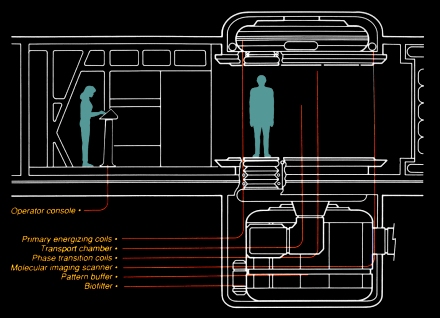 The concept of quantum teleportation is the
transmission and reconstruction of particles over an arbitrary distance
using a quantum system. This has been demonstrated/proven
experimentally, where a photon carries polarization to another pair of
photons, making them entangled. Then the second photon of the entangled
pair can get the polarization of the initial photon from any distance. The concept of quantum teleportation is the
transmission and reconstruction of particles over an arbitrary distance
using a quantum system. This has been demonstrated/proven
experimentally, where a photon carries polarization to another pair of
photons, making them entangled. Then the second photon of the entangled
pair can get the polarization of the initial photon from any distance.Quantum teleportation gained a lot of recognition by the general public due to its association to transporter and replicator technology in the science fiction show Star Trek. This recognition allows more people to be aware of the uses of science, increasing the amount of funding that institutions will put into its research and the amount of scientists interested in pursuing it. A major proponent of this technology is renowned theoretical physicist Micho Kaku. "You know the expression "Beam me up Scotty?" We used to laugh at it" Dr Kaku said in an interview with the Daily Mail. "We used to laugh when someone talked about teleportation, but now we don't laugh anymore. Quantum teleportation already exists and I think within a decade we will teleport a molecule". Kaku was responding to the results of an experiment in September 2016 when researchers at the National Institute of Standards and Technology (NIST) managed to teleport photons carrying quantum information over 102 kilometres of optical fibre, a distance that is four times greater than the one achieved in the previous record breaking experiment. This provides further evidence of science fiction's influence on research into quantum teleportation where it not only helps to publicise the research but also gives the researchers a goal to work towards.
|
||